

Coandă Effect Explained: Simple Observations to Smarter HVAC Design
In engineering, the most powerful insights often come from simple observations. One such phenomenon is the Coandă effect — a principle that explains why fluid flows tend to “stick” to nearby surfaces.
While it may seem subtle, this effect is fundamental to how we design efficient air distribution systems in modern HVAC applications.
What is the Coandă Effect?
The Coandă effect describes the tendency of a fluid jet (air or liquid) to attach itself to a nearby surface and follow its contour instead of moving in a straight line.
This happens because:
The moving fluid entrains surrounding air
A low-pressure region forms between the jet and the surface
The pressure difference “pulls” the flow toward the surface
In simple terms: air prefers to stay attached to surfaces when conditions allow it.
Simple Demonstrations
1. Blowing Air Along a Surface
Blow air parallel to a wall or across a curved surface (like the edge of a book).
You’ll notice the airflow bends and follows the surface rather than moving straight.
2. Paper Strip Demonstration
Hold a strip of paper vertically and blow across its top surface.
The air follows the curve of the paper
Pressure above the paper drops
The paper lifts upward
This combines the Coandă effect with Bernoulli's principle.
A Common Misconception
You may have seen the example of water flowing along a spoon. While visually similar, this is not a pure demonstration of the Coandă effect.
In that case, the behavior is strongly influenced by:
Surface tension
Adhesion between water and the surface
Engineering Applications
Aerospace
The Coandă effect is used to manipulate airflow over wings and control surfaces, improving lift and stability.
Automotive Design
It helps guide airflow around vehicle bodies to reduce drag and improve efficiency.
HVAC Applications: Where It Creates Real Value
In HVAC engineering, the Coandă effect is not just theoretical—it directly impacts comfort, efficiency, and system performance.
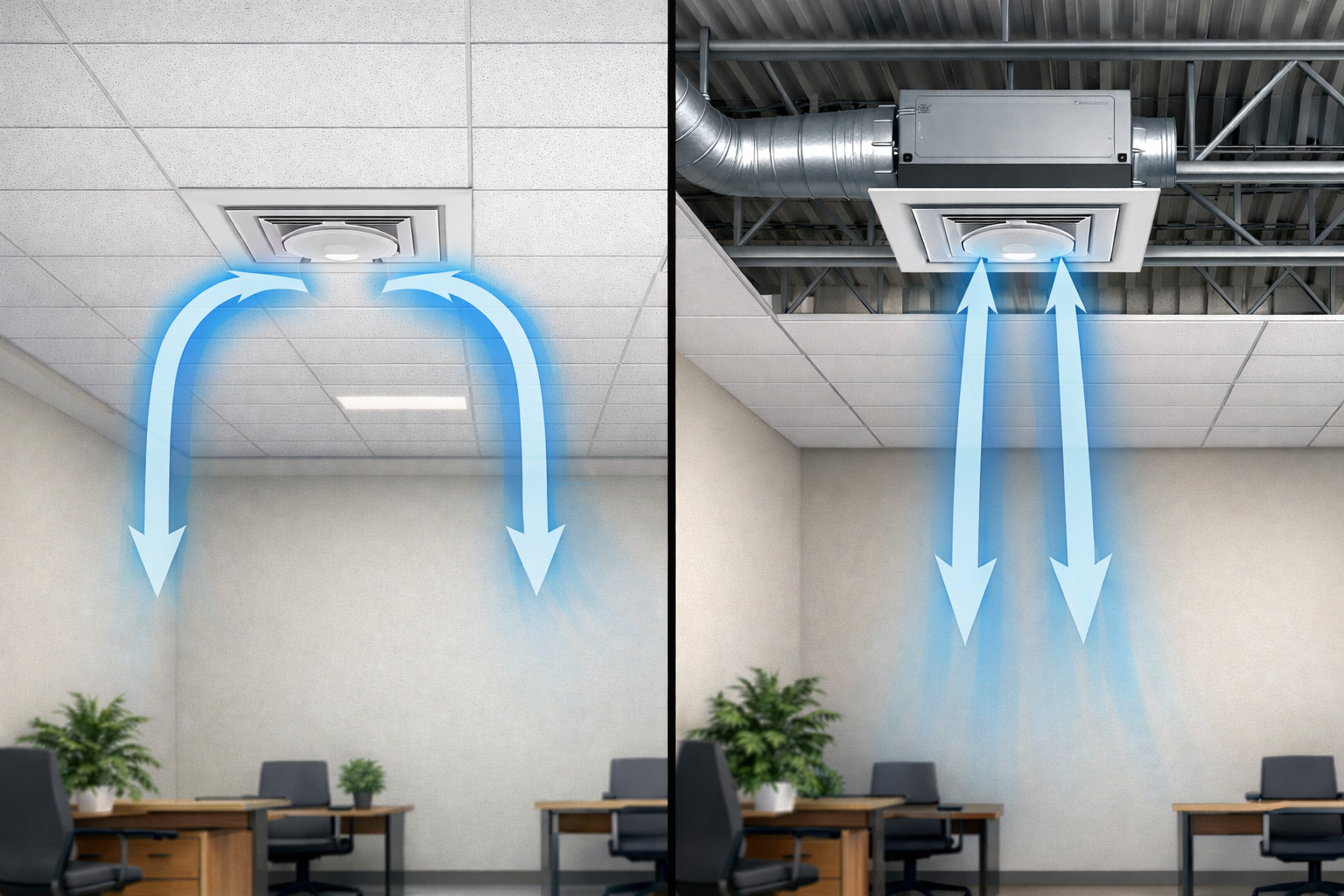
Diffuser on the left with adjacent ceiling is able to achieve a ‘wider throw’ due to Coandă effect compared to the diffuser the right without an adjacent ceiling.
1. Air Distribution from Ceiling Diffusers
Conditioned air supplied from ceiling diffusers attaches to the ceiling and travels horizontally before descending.
This:
Prevents cold air from dropping directly onto occupants
Eliminates drafts
Ensures uniform temperature distribution
A low-flow system that takes advantage of a ceiling and the Coandă effect can achieve what a high-flow system without a ceiling can achieve. This results in energy savings.
Without this effect, air would “dump” downward, leading to discomfort and poor mixing.
2. High-Induction Diffusers
Modern diffusers are designed to maximize entrainment.
By leveraging the Coandă effect:
Large volumes of room air are mixed with supply air
Temperature differences are reduced
System efficiency improves
Final Thoughts
The Coandă effect is a perfect example of how fundamental physics translates into practical engineering advantages.
From a simple airflow experiment to high-performance HVAC systems, the same principle governs how air behaves—and how effectively we can control it.