

Understanding Different Types of Valves in HVAC Systems
In any HVAC system, valves play a quiet but critical role. While chillers, pumps, and air handling units often get the spotlight, it’s the valves that regulate, balance, and protect the entire system. Poor valve selection or misuse can lead to energy inefficiency, low delta T, control instability, and maintenance headaches.
This article breaks down the most important types of valves used in HVAC applications—what they do, where they are used, and how to select them intelligently.
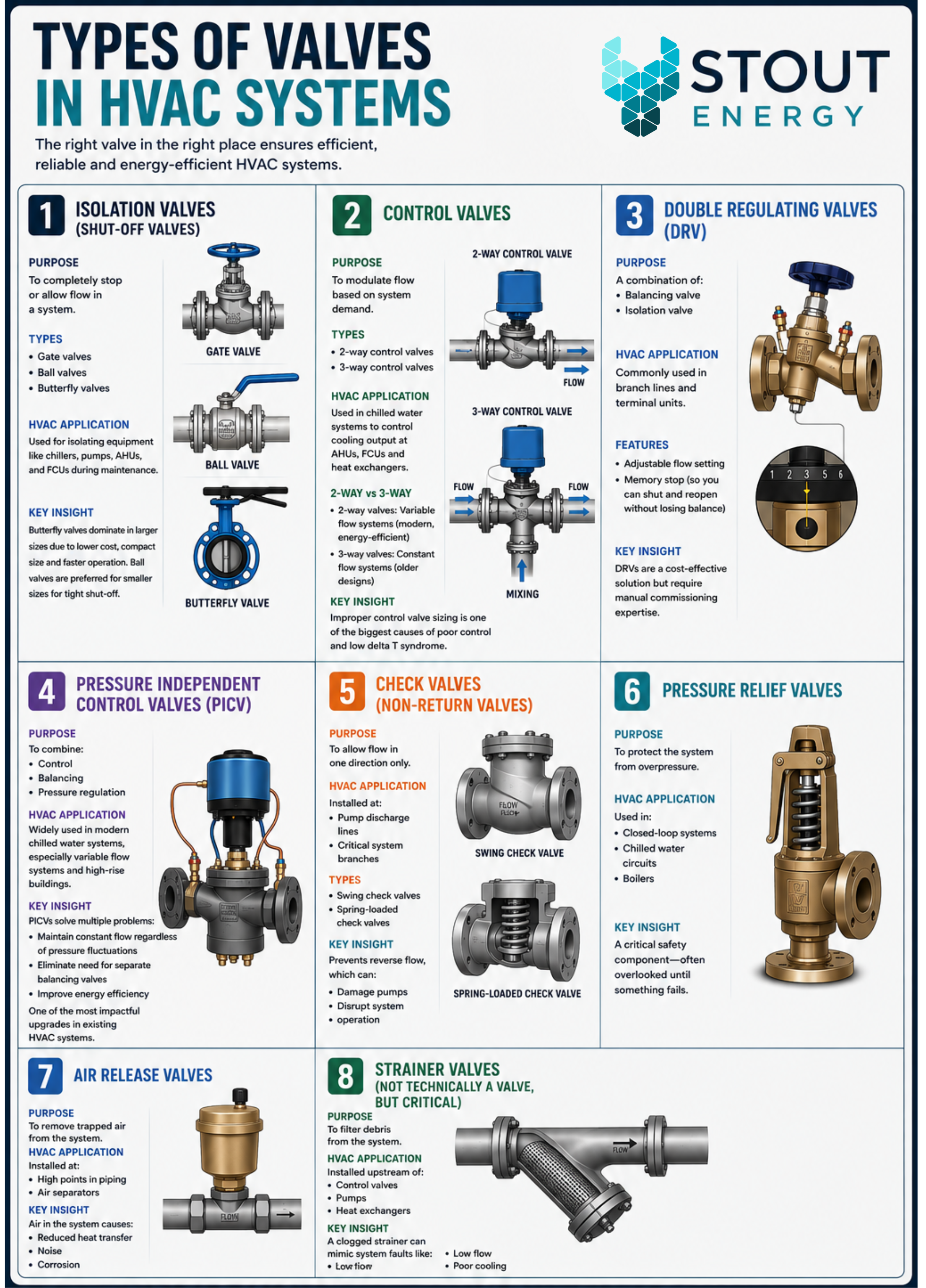
1. Isolation Valves (Shut-Off Valves)
Purpose: To completely stop or allow flow in a system.
Common Types
Gate valves
Ball valves
Butterfly valves
HVAC Application
Used for isolating equipment like chillers, pumps, AHUs, and FCUs during maintenance.
Key Insight
For HVAC systems today, butterfly valves dominate in larger pipe sizes due to:
Lower cost
Compact size
Faster operation
Ball valves are preferred for smaller sizes because of tight shut-off and reliability.
2. Control Valves
Purpose: To modulate flow based on system demand.
Types
2-way control valves
3-way control valves
HVAC Application
Used in chilled water systems to control cooling output at:
AHUs
FCUs
Heat exchangers
2-Way vs 3-Way
2-way valves: Variable flow systems (modern, energy-efficient)
3-way valves: Constant flow systems (older designs)
Key Insight
Improper control valve sizing is one of the biggest causes of poor control and low delta T syndrome.
3. Balancing Valves
Purpose: To ensure correct flow distribution across the system.
Types
Manual balancing valves (MBV)
Automatic balancing valves (ABV)
HVAC Application
Used to:
Balance chilled water systems
Ensure each terminal unit gets design flow
Key Insight
Without proper balancing:
Some coils get excess flow
Others starve
System efficiency drops significantly
4. Double Regulating Valves (DRV)
Purpose:
A combination of:
Balancing valve
Isolation valve
HVAC Application
Commonly used in:
Branch lines
Terminal units
Features
Adjustable flow setting
Memory stop (so you can shut and reopen without losing balance)
Key Insight
DRVs are a cost-effective solution but require manual commissioning expertise.
5. Pressure Independent Control Valves (PICV)
Purpose:
To combine:
Control
Balancing
Pressure regulation
HVAC Application
Widely used in modern chilled water systems, especially:
Variable flow systems
High-rise buildings
Key Insight
PICVs solve multiple problems:
Maintain constant flow regardless of pressure fluctuations
Eliminate need for separate balancing valves
Improve energy efficiency
This is one of the most impactful upgrades in existing HVAC systems.
6. Check Valves (Non-Return Valves)
Purpose: To allow flow in one direction only.
HVAC Application
Installed at:
Pump discharge lines
Critical system branches
Types
Swing check valves
Spring-loaded check valves
Key Insight
Prevents reverse flow, which can:
Damage pumps
Disrupt system operation
7. Pressure Relief Valves
Purpose: To protect the system from overpressure.
HVAC Application
Used in:
Closed-loop systems
Chilled water circuits
Boilers
Key Insight
A critical safety component—often overlooked until something fails.
8. Air Release Valves
Purpose: To remove trapped air from the system.
HVAC Application
Installed at:
High points in piping
Air separators
Key Insight
Air in the system causes:
Reduced heat transfer
Noise
Corrosion
9. Strainer Valves (Not technically a valve, but critical)
Purpose: To filter debris from the system.
HVAC Application
Installed upstream of:
Control valves
Pumps
Heat exchangers
Key Insight
A clogged strainer can mimic system faults like:
Low flow
Poor cooling
Final Thoughts: Why Valve Selection Matters
In HVAC design and retrofits, valves are often treated as standard components—but they shouldn’t be.
The right valve strategy can:
Improve system efficiency
Eliminate low delta T issues
Reduce pumping energy
Simplify commissioning
Enhance control stability
The wrong choice can quietly drain energy and performance for years.
At Stout Energy, we’ve seen that valve optimization alone can unlock 10–25% energy savings in existing chilled water systems—especially in aging buildings with poor hydraulic design.
Whether it’s upgrading to PICVs, correcting control valve sizing, or rebalancing systems, valves are often the lowest-cost, highest-impact intervention available.